
Innovation sits at the heart of UKNNL’s mission. As the UK’s national nuclear laboratory for fission, we are responsible for maintaining and advancing national nuclear capabilities and supporting industry to bring new technologies to market, a role strengthened by the 2024 Strategic Review.
Through a challenge-led approach, our bespoke innovation programme has developed technologies that address real operational challenges across the nuclear sector.
We have made, and continue to make, critical breakthroughs for the sector.
For this case study, we highlight projects which demonstrate the breadth and impact of UKNNL’s work.
Together, they show how our Innovation team is not just solving today’s technical challenges but also identifying, translating and applying new ideas in ways that create lasting value for the business, the sector and the wider world.
Novel approach to decommissioning
Surface decontamination using ultrasound technology
Turning nuclear expertise into cancer treatments
A novel approach to decommissioning
Challenge
As older UK nuclear facilities are taken out of service, decontamination techniques can be applied to remove radiological hazards and lower the overall waste volume that needs long-term storage and disposal.
A key challenge is choosing the right decontamination approach while meeting site-specific engineering constraints, waste acceptance criteria, and safety case requirements.
Facilities often vary in their condition, associated hazards, and waste types. This means no single method works in every situation and a range of decontamination technologies, including new and innovative approaches, is needed.
Gloveboxes are an example of a common piece of equipment that is found at many nuclear sites (Nuclear gloveboxes – Case study – GOV.UK).
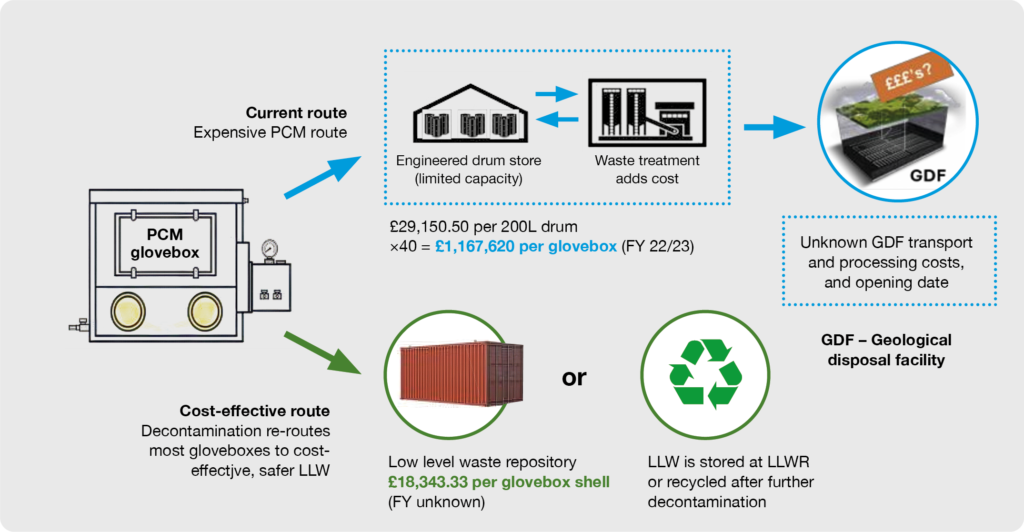
Decontamination techniques currently used in their decommissioning are often found to be ineffective, resulting in large volumes of waste requiring expensive storage. As illustrated below, huge cost-savings could be achieved if more effective methods were made available and applied.
Solution
To address the challenges of decommissioning nuclear facilities, UKNNL and partners have been developing and demonstrating a range of innovative techniques, prior to their implementation on UK nuclear sites.
EASD (Electrolytically Assisted Surface Decontamination) is one such innovative technology that uses an electric current to rapidly remove fixed surface-bound contamination from metallic wastes. The removed radioactivity is captured in a liquid or gel and safely managed through existing waste routes.
Aspigel 100E is another innovation (originating from France) that can be used to chemically clean large, contaminated areas such as metallic floors. It is applied wet but dries into a low-volume solid that can be easily collected and processed.
Both these processes enable metallic waste to be reclassified or recycled, supporting faster and more environmentally responsible decommissioning.
The diagram below illustrates the process developed by UKNNL for the application and secondary waste treatment of Aspigel 100E, and the training of workers prior to its demonstration at the Sellafield nuclear site.
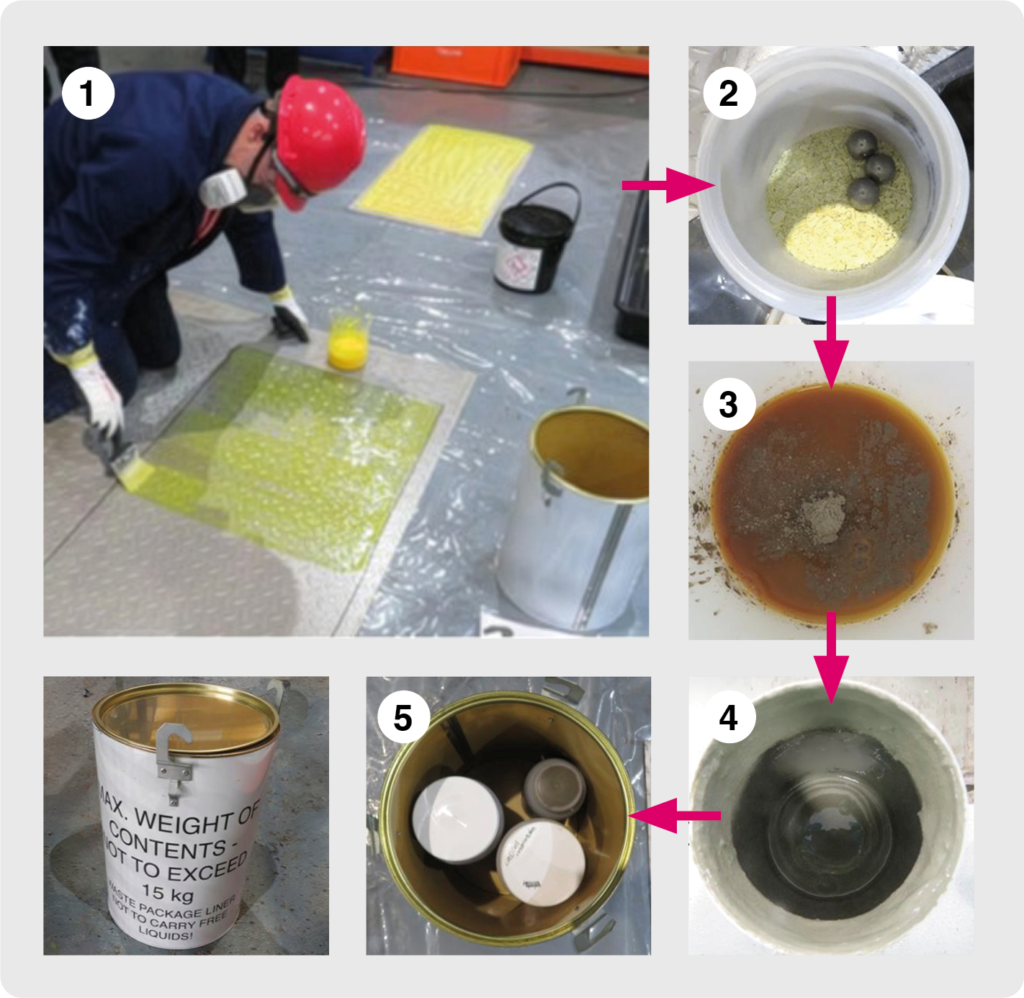
EASD and Aspigel 100E training at Sellafield.
- Trainee applying the Aspigel 100E to a contaminated floor mock-up
- Dried gel is collected and crushed
- Crushed waste is neutralised
- Neutralised waste is encapsulated
- All secondary waste placed in intermediate level waste package
What the future holds
The aim is to provide the nuclear industry workforce with a wider range of tools to support the delivery of UK nuclear decommissioning projects.
The next step is to utilise techniques such as EASD and Aspigel 100E on challenging waste items, such as contaminated gloveboxes, to help achieve decommissioning goals. Sellafield alone currently has more than 800 redundant gloveboxes, 350 of which contain plutonium- contaminated material.
Traditional ILW disposal costs around £1.2 million per glovebox, whereas reclassification to LLW reduces this to around £28,000. This represents potential savings of over £900 million, along with reduced storage pressures and improved waste management.
Overall, EASD and related methods are powerful tools that can help to significantly accelerate UK decommissioning efforts while minimising environmental impact and reducing long-term liabilities.
Surface decontamination using ultrasound technology
Challenge
Decontaminating nuclear waste is highly complex, particularly where grease, solvents, paints and radioactive residues adhere to pipework and equipment.
Irregular geometries, bends and restricted access make pipes especially difficult to clean, which means that conventional methods often fail.
Although ultrasound technologies are proven in other industries (e.g. jewellery, medical devices, automotive), standard immersion bath systems cannot withstand the harsh chemical and radiological conditions, nor can they be deployed effectively in nuclear plant environments.
A more robust, targeted ultrasound solution was therefore required to make the technology viable for nuclear decontamination.
Solution
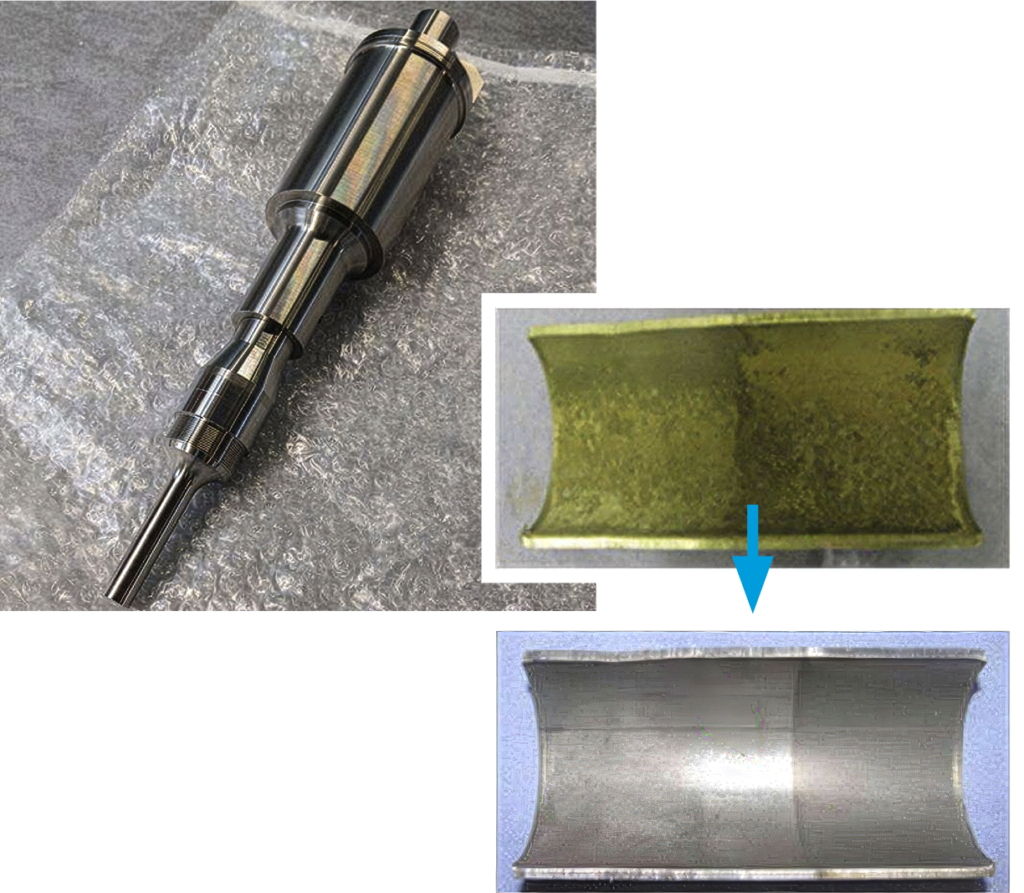
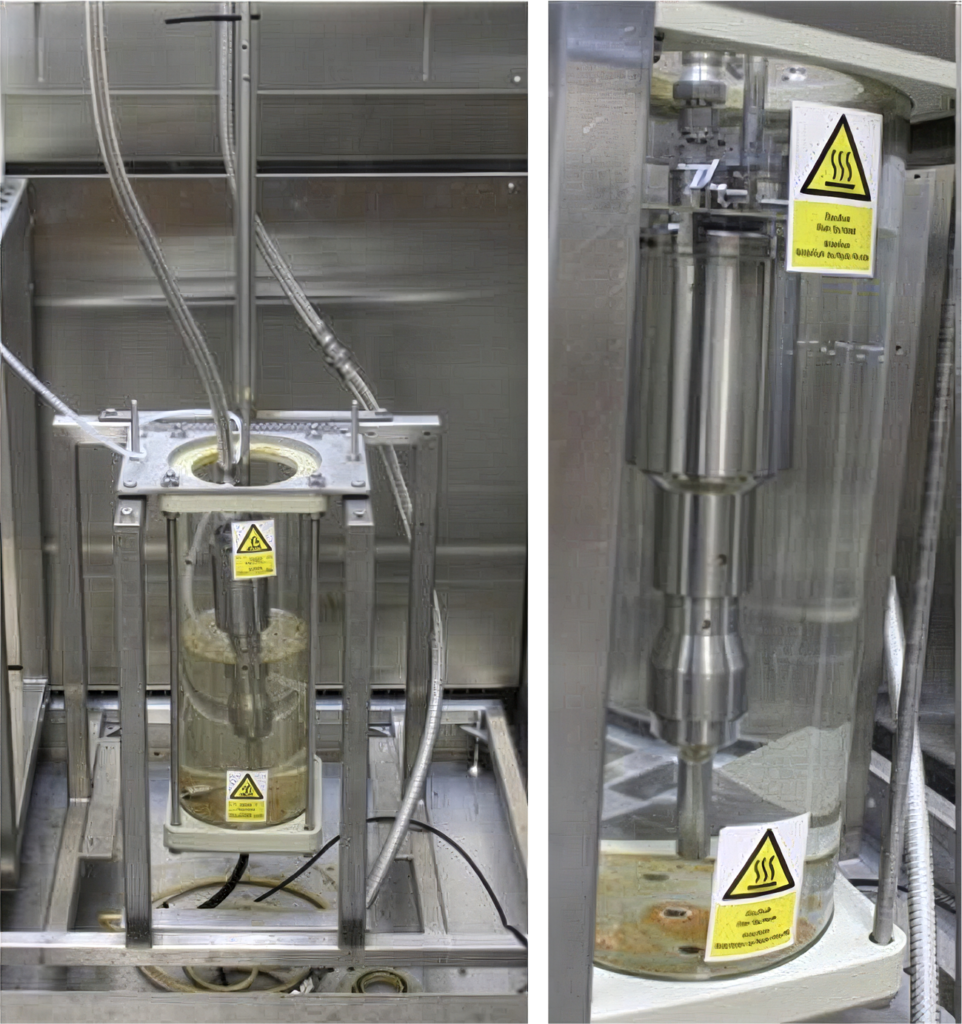
UKNNL’s Innovation programme invested to develop a ruggedised ultrasound device that focuses cavitation energy directly onto contaminated surfaces, thereby enabling effective cleaning in confined and complex geometries.
Unlike immersion bath systems, the device can be precisely targeted and is engineered to withstand harsh chemical and radiological environments while remaining settings.
We designed the system in collaboration with engineering colleagues and supply chain partners, and it was informed by operational experience at Sellafield and UKNNL sites.
Testing on both radioactive and heavily fouled non-radioactive pipework demonstrated strong performance across a range of contamination types, and the device is now chemically resistant and submersible in liquid.
This has enhanced the suitability of the technology for decontamination application in a range of settings.
What the future holds
The ruggedised ultrasound device can enhance chemical cleaning and has been shown to decontaminate materials in minutes, rather than the days or weeks required by conventional methods, delivering major efficiency gains for waste management operations.
Beyond surface cleaning, it can break down solids to keep them pumpable, thus reducing blockage risks and improving the performance of decontamination agents.
It also enables some wastes to be reclassified and recycled, significantly lowering both cost and hazard across the nuclear estate, and has the potential to become part of a wider decommissioning toolkit.
The programme has helped develop skills for the future workforce through early career talent and opened up new research opportunities, including novel oxidation chemistry applications.
Through the UKNNL Innovation programme, the ruggedised ultrasound device has been externally recognised through an award from the Government Office for Technology Transfer, validating innovation expertise and potential in this space.
Turning nuclear expertise into cancer treatments
Challenge
Almost 3.5 million people in the UK are living with cancer, creating an increasing demand for innovative radiopharmaceutical treatments. Among these are both emerging targeted alpha therapies and established treatments that use the medical radionuclide yttrium-90 (Y-90) to treat liver cancers and cancers that have metastasised.
The UK currently relies heavily on overseas supplies of many medical radionuclides, creating potential vulnerabilities in treatment availability and limiting opportunities to develop a secure domestic supply chain.
At the same time, valuable radionuclides exist within the UK’s nuclear legacy inventory. However, these materials are typically stored in locations or forms that make recovery challenging without disrupting ongoing decommissioning and waste management activities.
Solution
UKNNL’s Innovation team launched REAPER (REcovery of Alpha Patient Enhancing Radionuclides) to investigate how valuable medical radionuclides could be recovered from civil nuclear materials. While the programme initially focused on materials that could support future targeted alpha therapies, the research identified a more immediate opportunity to address demand for yttrium-90 (Y-90), a radionuclide already used in the treatment of liver cancers and metastatic disease.
To enable this, the team developed a modular recovery system that extracts radionuclides from more accessible liquid nuclear inventories, such as fuel storage ponds and process vessels. This approach minimises waste generation, reduces radiation exposure and avoids the operational challenges associated with retrieving material from solid waste stores.
Early development included the production of a 3D-printed prototype and the identification of a specialist material capable of selectively capturing strontium-90 from radioactive cooling pond water at the Sellafield site. The recovered strontium-90 can subsequently be processed within UKNNL’s active laboratories to generate yttrium-90, providing a potential domestic source of a clinically important radionuclide.
What the future holds
The REAPER programme is demonstrating how the UK’s nuclear legacy can be transformed into a strategic healthcare asset. By recovering radionuclides from existing nuclear materials, the programme could help establish a long-term domestic supply chain for medical isotopes, reducing dependence on imports and enhancing national resilience.
The work is also building specialist capability across both the nuclear and healthcare sectors, supporting PhD researchers and strengthening collaborations with organisations including Medicines Discovery Catapult, Queen Mary University of London and King’s College London.
As the programme develops, it has the potential not only to support current Y-90 cancer treatments but also to provide a platform for future recovery of radionuclides required for next-generation targeted therapies, helping position the UK as a leader in radiopharmaceutical innovation and advanced cancer treatment.
Summary
These examples show what can be achieved by applying scientific knowledge and investigation to problems across the nuclear sector.
From solving decommissioning challenges to repurposing our waste for positive purposes, such as improving human health, research programmes and collaborations like these continue to support UKNNL in achieving our purpose: nuclear science to benefit society.
Furthermore, such innovation programmes will continue to provide skills and experience for early-career researchers and contribute to the retention and development of our nuclear know-how.