Thursday 9 July 2026
Recognised on the World Stage: 45 Years of Keeping Nuclear Materials Secure
The UK’s contribution to the global nuclear safeguards programme has received formal recognition from the International Atomic Energy Agency (IAEA), and United Kingdom National Nuclear Laboratory (UKNNL) is right at the heart of that achievement.
Nuclear safeguards are the technical measures used to verify that states comply with their international treaty obligations not to misuse nuclear materials, and they are an essential part of the global non-proliferation regime.
UKNNL has formally managed the UK’s contribution to this system on behalf of the Department for Energy Security and Net Zero (DESNZ) since 2008, providing technical leadership, budget management, and subcontractor oversight, while also delivering significant parts of the programme directly.
The Recognition
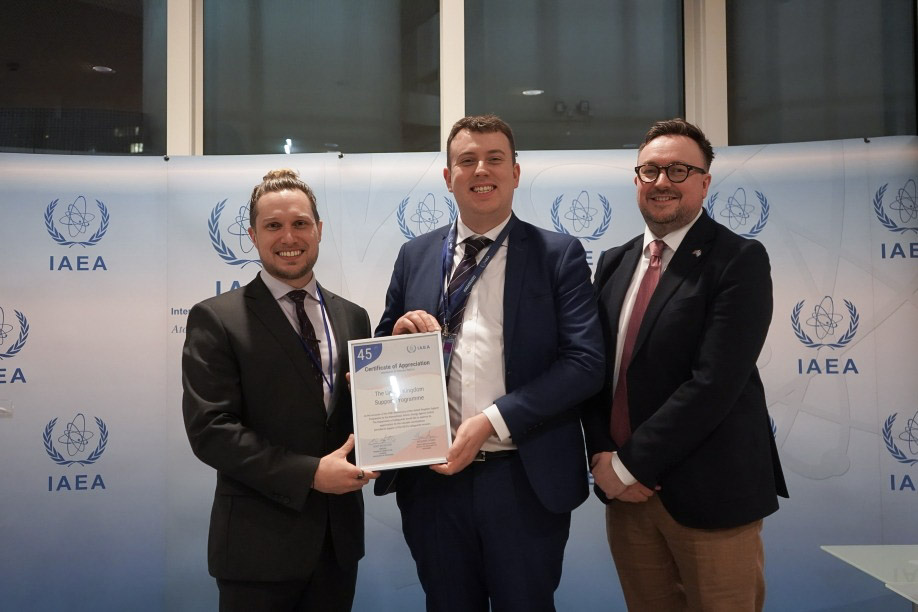
At the recent Biennial Coordinators’ Meeting in Vienna, the UK received a certificate of appreciation from IAEA Deputy Director General Massimo Aparo, in recognition of 45 years of continuous support to the global nuclear safeguards system. The certificate was presented to Ian Millar, the UK’s Deputy Permanent Representative to the United Nations and other International Organisations in Vienna, with UKNNL’s Mat Budsworth, Laila Rees and Sadie Stewart present at the ceremony alongside Angus Girling from DESNZ.
The IAEA exists to ensure that nuclear material around the world is only ever used peacefully, verifying that countries are not diverting material to make weapons. Its regular UN budget is modest, so it depends on financial and technical support from member states and the UK is among the largest contributors, both in terms of investment and technical knowledge.
Between 2021 and 2024 alone, the UK’s contribution delivered over £5 million across more than 35 separate tasks. It is the breadth, consistency, and quality of that commitment over 45 years that the IAEA has now formally recognised.
What UKNNL Delivers
At the core of everything UKNNL does under this programme is a single purpose: ensuring that nuclear material is never produced or diverted for weapons programmes undetected. UKNNL administers the UK’s contribution to the IAEA’s safeguards system — the formal verification architecture that underpins global confidence in nuclear non-proliferation. When IAEA inspectors visit nuclear sites and collect samples, those samples are sent to one of the UK’s two IAEA-accredited laboratories, at UKNNL Preston and AWE Aldermaston, for analysis to the highest international standards. It is, in effect, an independent forensic service for the nuclear world.
UKNNL has been training IAEA inspectors since 1981, running courses that range from hands-on visits to UK nuclear fuel cycle facilities to sessions on identifying illicit nuclear activity and diplomatic negotiation skills for inspectors working in difficult environments. A visit to the decommissioning Chapel Cross reactor site in Annan, Scotland, earlier this year drew particular praise from the IAEA
Beyond analysis and training, UKNNL helps build the wider intelligence and technology infrastructure that modern safeguards depend on. This includes supporting the IAEA’s use of commercial satellite imagery to detect undeclared nuclear facilities, funding multi-lingual Regional Information Collection Centres that gather open-source intelligence from around the world, developing new inspection instruments and equipment, and working on safeguards considerations for Small Modular Reactors. Through the “Cost-Free Expert” scheme, UKNNL also places UK specialists — including satellite imagery analysts and nuclear material accounting experts — directly inside the IAEA in Vienna, keeping British expertise at the heart of international nuclear governance.
Why This Matters
The certificate of appreciation reflects the sustained, high-quality contribution that the UK and UKNNL have made to one of the most important systems in global security. This is what supporting national and international security through nuclear expertise looks like in practice. It is UKNNL’s purpose, nuclear science to benefit society, in action.